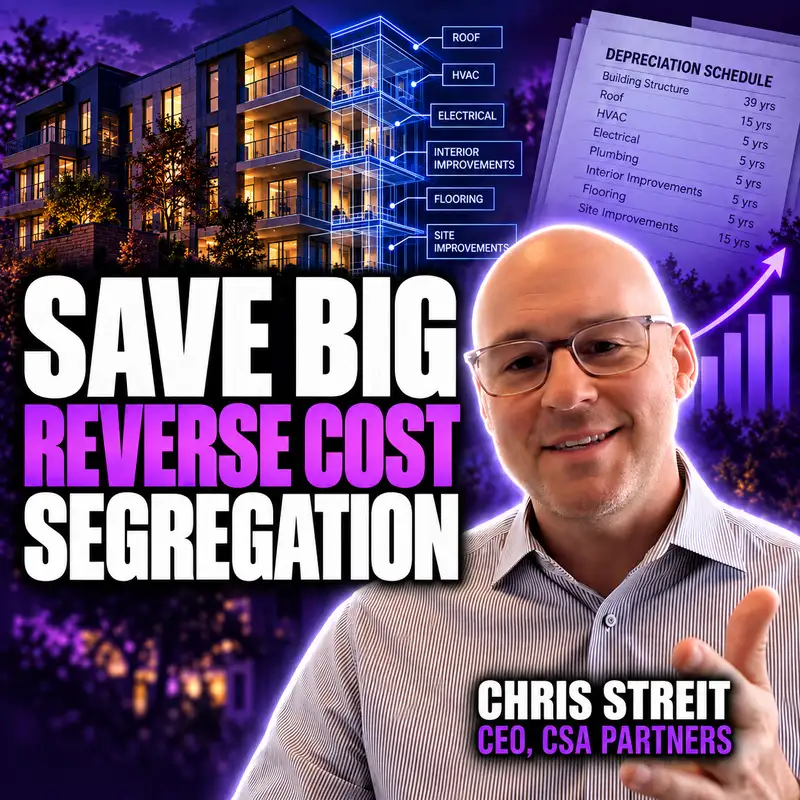
Ep. 205 | Save Big with Reverse Cost Segregation
Download MP3Everybody, and welcome back to the podcast. John Tripolsky here from the Teaching Tax Flow team here in the Strategic Associates studio. Thank you again to that team over there for supporting us and everything we do and putting out this fantastic tax planning and strategy content for you, the taxpayer. So on a topic today, my cohost here is going to jump into it with a fantastic guest, and we are going to go straight down the path of reducing and minimizing the taxes you will pay when you sell a property. So without further ado, Chris Picciurro, take it away, sir.
Chris Picciurro, CPA:Well, I'm really excited to have Chris Streit from CSI Partners back. We had an amazing time on our farm strategy podcast, and we're back to talk about a way to legally and ethically reduce the tax you pay when you sell a property. There are so much content out there, and we have put a lot of information out there on the tax advantages of owning real estate, but there are several things you could do when you exit said real estate. And one of those strategies is to reduce the tax you pay on it. We when you sell a property, there are different types of tax that you're paying.
Chris Picciurro, CPA:Right? You're paying some depreciation recapture. You're paying some long term capital gains. And what people don't understand, and we do have a lot of stuff on this too is that different income is taxed at different rates. So if we can strategize and maximize the amount of gain allocated to a lower rate and minimize the amount of gain allocated to a higher rate, we want to do that.
Chris Picciurro, CPA:So I again, Chris Streit from CSI Partners. Welcome back. You are going to walk us through the section twelve forty five exchange strategy, or I like to call the reversed reversed. The well, I'm not playing Uno here. The reverse cost segregation study.
Chris Streit:Awesome. Yeah. Great. Great to be on again. Always enjoy the conversation.
Chris Streit:And one of the funnest topic topics to talk about in real estate and tax, there's gotta be out there. So looking forward to get going.
Chris Picciurro, CPA:Well, what I love about this topic is that similar to because it's a reverse cost segregation study, but similar to implementation like that, this is something that someone can do that has sold their property, probably had a cost segregation performed on it previously. We're seeing a lot of people that bought short term rental properties right after the pandemic, and quite frankly, they they took advantage of what we call that short term rental tax loophole. And then they get tired of operating this property, and they wanna exit. Or maybe the property is not performing to the level they want it to be. And they wanna sell it, but they're too afraid of a huge tax they're gonna pay on something called depreciation recapture.
Chris Picciurro, CPA:But sometimes they sell it, and as long as they haven't filed their tax return, this implementation or this strategy could still be in place. So can you explain to me in the audience what? Is a Section twelve forty five exchange?
Chris Streit:Sure. Well, to begin, it's it's good to understand what a cost seg is when you do it. So a lot of people see it and they get excited about it and they get a big windfall of tax benefit if they did the short term rental loophole, or if they owned their property that had went on and it sits in a massive deduction that you get a time value of money benefit because that bank is no longer with the federal government, it's sitting in your account. What happens when you sell the property? This is often not a big discussion.
Chris Streit:People have to learn it the hard way. When you sell the property, the twelve forty five tax code defines how you go about valuing the property to determine how much you pay back and what you depreciated originally. So in short, a cost seg is a 0% loan from the federal government. The way it stands today, you give back dollar for dollar. That's something that people usually find out when they sell and they have to write a big, big tax check.
Chris Streit:What a twelve forty five is, is it basically takes the twelve forty five tax code and does explicitly the things it asks you to do in great detail to reduce that amount. Now, the reason why this is done and why it's a little bit more intricate and why it has a name is because there's basically a two part option for you when you value these assets that you depreciated. You can take exactly what you cost segued them at or what you valued them when you bought the property and pay that back dollar for dollar. That is the most common way it's done because it's easy. It takes thirty seconds to transfer that information over.
Chris Streit:The next, inside the code, it's very explicit. It tells you two things. It tells you you can use a fair market value, which is a code word telling accountants not to use book value. It's saying use fair market value and what it trades at in the market. And then it says determine the economic obsolescence of this.
Chris Streit:So how do you do that? Well, the things that you cost seg are microwaves, floors, carpets, things like that. How do you know what those are worth after they've been used for five years? It's not readily available. That's what a twelve forty five exchange does or reverse cost seg.
Chris Streit:It values them based on their fair market value and the economic obsolescence, the time of sale, and that degree of obsolescence reduces the base that you have to pay back and recapture.
Chris Picciurro, CPA:Especially if for those of you that have owned a short term rental property, trust me, nothing lasts more than two years. Not the TVs get destroyed. The carpeting gets torn up. The window. I mean, it's just there's a lot of maintenance costs, we'll say, but
Chris Streit:they get ridden hard for sure.
Chris Picciurro, CPA:Ridden hard and put away what? That's what my mom would say in in sometimes. So so let's think about an example, Right? And it could be a short term rental property. It could be an apartment building you acquired.
Chris Picciurro, CPA:But let's just say you've purchased an asset for a million dollars and you performed a cost segregation study on it. You qualified to take that immediate deduction at a 100% bonus appreciation, either your rep status or your or your have material participation from short term rental property. But let's say you bought the property for a million dollars and you were able to take, and let's pretend there's no land allocation just for easy math. Right? And you were able to take a $350,000 immediate deduction based on a cost segregation study.
Chris Picciurro, CPA:So from a technical perspective, and stay with us, everybody, we've reclassified that from real property, real estate to personal property, meaning you got 100% bonus depreciation. But when you sell that property, that personal property portion, that's a that's a lot to say, right? That the tax you pay on that recapture is much higher than a capital long term capital gain treatment assuming you owned it for more than a year. And from my understanding, what a 12 section twelve forty five exchange does does is it it takes a look at that personal property portion and reallocates it so you could potentially consider that long term gain instead of recapture of personal property.
Chris Streit:That's exactly right. And here here's here's the way the way it might look, and especially if you could if you are somebody who owns a property right now, you could probably start to see this take effect. And just like all tax law, there's these things that you agree and understand in principle and conceptually, but how do you prove it is the key thing. What's the backup for it? So if I'm walking through my property and I've owned it for five years and it's been ridden hard, I'm looking around and probably that $350,000 that was personal property that we reclassified and pulled forward, All those assets are your carpet, are your cabinets.
Chris Streit:They're basically everything but the pier beams and sheet rock that you have on property. They're probably all worth nothing economically in the market. And the way this definition works, the way fair market value works, it's not value in use. This is something that often gets conflated. Value in use means carpet cut for my living room is valuable because it's cut precisely for my living room, and I like the color perhaps.
Chris Streit:The economic value is that carpet cut out, rolled up, and put on the street with a for sale sign on it. So what does that go for? Well, whatever that is now valued at when you sold it, and it does have a value, it's not zero, it may seem like it, it has a value, whatever that value is, that amount is now your new recapture basis. So as Chris described, what we have to pay back in ordinary income rates now is a much lesser value, but the negative value has then shifted back to the real estate. It's been absorbed and salvaged by the real estate.
Chris Streit:So it expands your long term capital gain, but it reduces what you're paying in ordinary income on the recapture on personal property.
Ad Read:This episode is sponsored by Wealth Builders Mortgage Group, powered by Movement Mortgage, one of the top mortgage teams in the nation and a powerhouse in the real estate investing world. With over $1,100,000,000 in closed mortgage volume and more than 3,000 investor deals under their belt, They don't just talk the talk, they walk it. Their team specializes in helping short term and long term rental investors scale smart with customized lending strategies. They offer all STR loan products, including second home, investment, non QM, bank statement, asset based, and HELOCs. They also offer all primary home loan products, too.
Ad Read:Whether you're just starting out or expanding an existing portfolio, their unique path of 10 strategy is designed to help you move from a nine to five job to financial independence. If you're looking for a lending partner who truly understands the investor mindset, visit wealthbuildersmortgagegroup.com and start building your roadmap today.
Chris Picciurro, CPA:So to be clear, we are you have the same amount of taxable income by doing a section twelve forty five exchange. However, we're reclassifying the treatment of your gain. So to put numbers to it, if you had $500,000 of gain, right, that was because of its treatment was going to be taxed at 37%. Okay? It is now gonna be taxed at 15%.
Chris Picciurro, CPA:22% of 500,000 is a $110,000. That is a so that would be a tax reduction of a $110,000 even though you have the same amount of taxable income?
Chris Streit:Exactly. And and it is a permanent tax savings, different than cost seg. So cost seg is often billed as a tax savings opportunity, which it is, but those savings aren't defined. The way to classify those savings are how much do I defer and how much can I earn on that money? So I always encourage clients who are accelerating depreciation, number one, don't go to Las Vegas with your savings.
Chris Streit:Use the money to add value to your property or invest in another property. And if you don't have one to do that on right now, put it in a CD and earn 4%. If you did bring forward $350,000 as you mentioned in your first example, you could be earning $13,000 a year in interest as you own the property. That's the value. What twelve forty five does is it just it not only takes something that's a 0% loan.
Chris Streit:Again, a 0% loan from the federal government, no underwriting. Incredibly valuable to begin with. Yes. Twelve forty five lets you keep some of the principal when you sell. That is not just a good investment.
Chris Streit:It's the best investment in existence today.
Chris Picciurro, CPA:Yes. What type of properties are you seeing tend to be the best candidates in today's environment?
Chris Streit:So it does mirror the ones that are good cost seg candidates, and those look like things that have a lot of short life assets in them that can be accelerated, because the revaluation that's happening is the amount that was accelerated upfront. So even your short term rentals, your single family homes, they're excellent candidates because they have a lot of improvements and there's a lot of acceleration there. The key thing to think about when it does make sense and whether or not it follows the tax flow IQ method would be if it is the amount that's accelerated. So if we're dealing with the single family home that was a basis that you paid 150 or 200,000, there's probably not gonna be a lot of benefit there from a recapture. For twelve forty five exchanges, we typically see a basis threshold of around $400 From there, most assets are excellent candidates with the exception of those that may have limited personal property in them.
Chris Streit:Let's say if it's a smaller industrial warehouse that might only be $500,000 and there's only 8% personal property. But everything else is great. Homes we typically see when we hit that $400,000 mark, we're able to save people 17,000 to 20,000 when they sell, and it only cost them $3,000 do it. So they're netting out 15 they wouldn't had otherwise.
Chris Picciurro, CPA:Right. Right. And if you are a real estate investor and you've never heard of this or you've never heard of this from your accountant, your CPA, agent, that's common, right? This is not something that typically gets thought of because it's done right before the sale or after the sale. But but if you've sold a property and, you know, in the middle of the year, you have until you file your tax return to the for the next year to actually have the study performed, which is great.
Chris Picciurro, CPA:Another get out of jail free card. Are are entities eligible for this? In other words, if if it's a multi member LLC or or you know, we really advise us corps not owning rental property. But, yeah, are, yeah, are multi member LLCs or entities taxed as partnerships eligible?
Chris Streit:They are they are, and they're perfect for it because it flows through the k ones. I would say the ones that are they're eligible, but it doesn't make sense are C Corps because they're already at a 20% tax rate for their income. So the gain is definitely not there because it's about the rate arbitrage. But on your point about, you know, if you wanna talk to your accountant about it or they'd never heard of it, the big thing I'll just a real quick story on how it became something that we do and we focus on, we've been doing it for a little over ten years. Our business does well when we partner with a CPA and the CPA refers us a lot of business.
Chris Streit:One CPA in particular said, I want you guys to revalue assets for me so I can use section twelve forty five and save my clients money. We didn't have the systems built to do it, so we had to manually go in and do it. We made no money on it, but they sent us over engagements a year, so we wanted them to be happy. What we did as a firm, and the reason this intersection happened to be able to offer it to the market, we're also owned by another firm, we're owned by a private equity firm who has multiple portfolios that I actually came from that firm that specialize in state and local tax. We knew how to value personal property because we fought it at the state and local level.
Chris Streit:So we acquired all the same data that that firm bought, and we put it into a technology that allows us to do it now and not lose money. It's extremely expensive, but we've democratized that expense. So that way, if somebody's selling their short term rental, they can do it without having to pay the 6 figure sum to get a third party appraisal and all the legwork that goes into revaluing personal property. You have a path. You have a really hard way to go value things or just do what you did at the beginning and still you know, still have hours left in your day.
Chris Streit:That's why they haven't heard of it.
Chris Picciurro, CPA:Well, I'm gonna put this reverse 10 reverse cost segregation cost segregation study. I'm having a problem saying that on my list of favorite post year end tax strategies. We are big advocates of tax extensions at Teaching Tax Flow. We feel like you the best result possible is what we should be looking for. So if you're that taxpayer, like I said, that has sold a property or it's January, February, March, and you're thinking, oh, I sold this property.
Chris Picciurro, CPA:I I see this big this depreciation recapture, file an extension, make a payment, talk to your tax professional, and really take a look at this. And if you're a tax professional and you have clients that you know have sold properties, you know, we have we have a couple clients that we've already started working on together that I think there's gonna be a significant tax savings because, again, you can you can also pair if you're gonna reclassify a gain into a capital gain, now you might have capital losses elsewhere on the return that you can offset that gain. So there's a lot of things that we we say, you know, tax implementations don't like to be single. They like to mingle, and they like to jingle, like to be stacked and blended. Mhmm.
Chris Picciurro, CPA:And this is another it's just another tool in our toolbox for real estate investors that are exiting because, Chris, I don't know how you and is it I'm gonna wrap it up with just what you're saying because you are on the front lines and you are a nationally respected speaker on this topic. Are you seeing more, I guess, an increase of people exiting their properties versus, you know, kinda like I just felt like during the 2020 to 2022, we had a lot of people buying those short term rental tax, short term rental properties.
Chris Streit:Yeah. And that that's it's starting right now, and it's something that probably a lot of people are thinking about, because we do have a debt wall. These are all mostly ten year instruments that have refinancing in five years, so those are all happening right now, and people are being forced into higher rates, and also it costs more money to maintain a property, and rents aren't exactly up right now. So it's creating a challenging situation. And with that, why strategy is going to be even more impactful is because those were all properties acquired with 100% bonus depreciation.
Chris Streit:So all the short life was accelerated in year one. And by doing that, the basis in the property, basically, while you might be economically underwater, tax wise, you still have a gain. And what's interesting about that, which is something that we started using the $12.45 exchange a lot for, even if you don't have a gain, if you sell the property a couple of, within that five year period, you're still flagged within the IRS as owing recapture and they'll take out of the new property. So you don't get out scot free. So we might be able to take something down to a loss by doing a $12.45 exchange, which can be impactful.
Chris Picciurro, CPA:That's one of our other laws of tax planning. Tax flow and cash flow are different. And and remember that what you get at closing has very, very little bearing on your taxable gain and how I have taxable gains eligible. And you might not get anything in closing. You might have to come to the you might be have a distressed sale where you actually have a taxable gain and you have to bring money to the table.
Chris Picciurro, CPA:So definitely, if you're if you are a tax professional and you have a client that has sold a property and we have you have an open tax return, really look at the property. As Chris said, if it if its basis is over 400,000 or more, take a look at this opportunity. If you need help with this, jump into our community, or or, we're gonna have a we're gonna have a form you can fill out to get a little more information on this. Or if you're property owner and you got distressed and you wanna sell a property or here you have sold a property already, this is something you wanna take a look at. So, Chris, thank you so much for joining us again.
Chris Picciurro, CPA:We really appreciate your knowledge and time.
Chris Streit:My pleasure. And if I could add one more thing too, there's a lot of people out there who say, you know what? I don't wanna do a cost seg because I'm selling the property in two or three years. Stop for a second and do the math. With something like this, it might change your mind.
Chris Streit:Don't make a bad decision just because recapture is a scary word. You might come out in positive as a result. Thank you, Chris, so much.
Chris Picciurro, CPA:No, that's a great point. And thanks again. Everyone have a great rest of the day, and let's save money on our taxes. Let's do it. The
Disclosure:information in this podcast is educational and general in nature. It reflects the opinions of Teaching Tax Flow and does not take into consideration the viewer's personal circumstances. It is not intended to be a substitute for individualized financial, legal, or tax advice. Consult the appropriate qualified professional prior to making any decisions. Securities are offered and supervised through Cabin Securities Inc member, FINRA SIPC.
Disclosure:Investment advisory services are offered and supervised through Cabin Advisors LLC, an SEC registered investment advisor. Chris Picciurro is a registered representative of Cabin Securities and an investment advisor representative with Cabin Advisors LLC, teaching Tax Flow as an independent entity and is not affiliated with Cabin Securities or Cabin Advisors.